CodeMetaSoft

Project duration
1 November 2024 – 31 October 2026 (24 months, completed)
Total funding
€250,000
Principal investigator

Daniel Garijo and Thomas Vuillaume
Universidad Politécnica de Madrid and Laboratoire d'Annecy de Physique des Particules
BIO
Daniel Garijo is a researcher at the Ontology Engineering Group of the Universidad Politécnica de Madrid. His line of research is at the intersection of Knowledge Capture, e-Science and Semantics, in particular on capturing the context and metadata of research software and computational experiments to promote their (re)usability.
Thomas Vuillaume is a data scientist and research software engineer working at Laboratoire d'Annecy de Physique des Particules (LAPP), CNRS. His line of research focuses on developing data analysis pipelines, including machine and deep learning methods, to extract information from the Cherenkov Telescope Array Observatory (CTAO) currently under construction.
QUOTE
"Metadata gets written once and then left to rot. The gap is maintenance, not adoption."
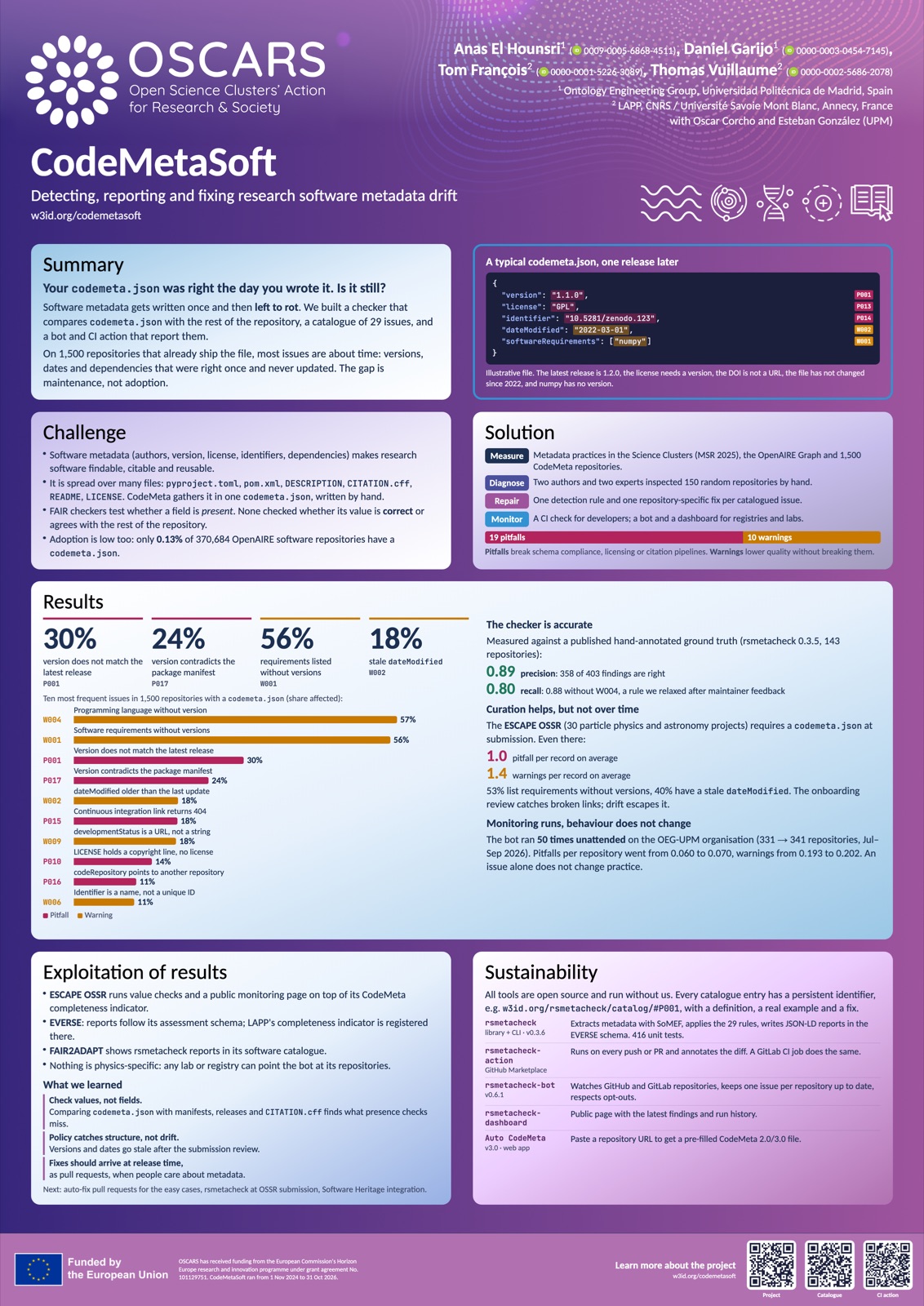
SUMMARY
Research software metadata (authors, version, license, identifiers, dependencies) is what
makes software findable, citable and reusable. CodeMeta describes it in a single
codemeta.json file, but developers write that file by hand and rarely update
it. CodeMetaSoft measured how often this metadata goes wrong, catalogued the problems, and
built open-source tools that detect them, report them to maintainers and suggest fixes.
Research domains:
Research software engineering; FAIR research software metadata; use case in particle physics and astronomy. The tools work for any domain.
Partner(s):
Universidad Politécnica de Madrid (UPM, Ontology Engineering Group), Spain; Laboratoire d'Annecy de Physique des Particules (LAPP, CNRS / Université Savoie Mont Blanc), France
Project team member(s):
Daniel Garijo (co-PI, UPM), Thomas Vuillaume (co-PI, LAPP), Anas El Hounsri (UPM), Tom François (LAPP), with contributions from Oscar Corcho and Esteban González (UPM)
CHALLENGE
Software metadata is scattered across many files: package manifests
(pyproject.toml, setup.py, pom.xml,
DESCRIPTION, package.json), CITATION.cff,
README and LICENSE. A codemeta.json gathers it in one
place, then drifts away from the code: the version stays two releases behind, the license
says "GPL" without a version, the author list differs from the one in
CITATION.cff. Existing FAIR checkers test whether a field is present. None of
them checks whether its value is correct or matches the rest of the repository.
WHAT WE DID
UPM, which develops the SoMEF metadata extractor, and LAPP, which coordinates the ESCAPE OSSR software repository, worked in four steps:
- Measure. We studied metadata practices in the European Science Clusters, in
370,684 software repositories of the OpenAIRE Graph and in 1,500 repositories that ship
a
codemeta.json. - Diagnose. Manual inspection of 150 repositories produced a catalogue of 29 issues (19 pitfalls, 10 warnings). Each has a persistent identifier, a real example and a suggested fix.
- Repair and monitor. We built open-source tools around the catalogue: rsmetacheck detects the issues and suggests repository-specific values, rsmetacheck-action runs it in GitHub or GitLab CI, rsmetacheck-bot watches a list of repositories and opens one issue per repository, and rsmetacheck-dashboard publishes the results.
- Generate. The Auto CodeMeta
generator pre-fills a
codemeta.jsonfrom a repository URL, and the bot proposes one when a repository has none.
Reports follow the EVERSE assessment schema, so other quality tools can read them.
KEY RESULTS
- Metadata rots. Among 1,500 repositories that already publish a
codemeta.json, 30% declare a version that does not match their latest release, 24% a version that contradicts their package manifest, and 56% list requirements without versions. What is missing is maintenance, not adoption. - Curation helps, but not over time. The ESCAPE OSSR, which requires CodeMeta, averages 1.0 pitfall and 1.4 warnings per record. Its onboarding review catches structural errors but not drift.
- CodeMeta is rare elsewhere. Only 0.13% of OpenAIRE software repositories have a
codemeta.json. - The tools work. rsmetacheck matches a manually annotated ground truth with a precision of about 0.89. The bot runs on the OSSR and on the repositories of the OEG-UPM organisation.
- Issues alone do not change practice. Metadata quality did not improve in two months of bot runs. Researchers care about metadata when they release or publish, so fixes should be offered at that moment.
IMPACT FOR THE SCIENCE CLUSTERS
- ESCAPE / OSSR now has a metadata check that tests values, not only field presence, and a public monitoring page. Several maintainers applied the suggested fixes. Results are in ossr-metadata-analysis.
- EVERSE: rsmetacheck output follows the EVERSE assessment schema, and the CodeMeta completeness indicator from LAPP is registered as an EVERSE indicator.
- FAIR2ADAPT shows rsmetacheck reports in its software catalogue.
- Any community: nothing is specific to physics. A lab, registry or Science Cluster can add the action to its CI or point the bot at its repositories.
This page was built on a free template designed by FreeHTML5.co (© 2016 Free HTML5)